

Beyond the Student: How Virginia Tech Empowers Families as Strategic Partners
How Virginia Tech's "mirror experience" solves the family engagement puzzle—empowering parents as strategic partners without overwhelming students or duplicating work.
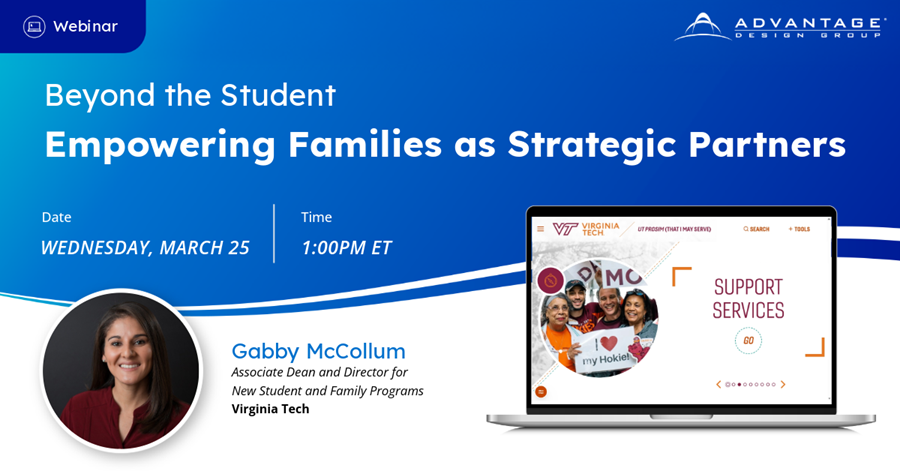
When Gabby McCollum, Director of New Student and Family Programs at Virginia Tech, set out to redesign their orientation experience, she faced a challenge: how do you meaningfully engage families without overwhelming students or creating twice the work? Her answer was the "mirror experience" - a dual-track orientation model that treats families as strategic partners from day one. With Advantage Orientation®, Gabby and her team created parallel student and family experiences that share similar content but communicate it differently, giving families the knowledge and tools to support their student's success while keeping the student experience focused and engaging.
The impact? Fewer panicked parent emails, family feedback that directly shapes improvements, and a model that proved so effective at eliminating barriers, the vast majority of Virginia Tech's incoming students now complete their entire orientation without ever stepping foot in Blacksburg.
Removing Barriers for All Students
Before COVID, there was only one way to register for classes at Virginia Tech: physically attend in-person orientation in Blacksburg at specific dates based on a student's college. For students coming from out of state or navigating work schedules and transportation challenges, this presented significant barriers. After a 2016 directive from Virginia Tech's President Sands charged the institution with better serving underrepresented students, especially those who are Pell-eligible, and COVID made travel unrealistic, it became clear that accessibility wasn't optional anymore.
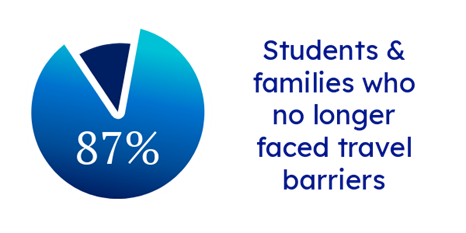
Virginia Tech's response was strategic. First, they decoupled orientation from academic advising and registration. Second, they implemented a required online orientation and kept in-person orientation as an optional supplement for those who could and wanted to attend. The impact was astounding. 87% of Virginia Tech's 2025 incoming class only attended online orientation, eliminating travel barriers for thousands of students and their families.
Empowering Two Audiences
The genius of Virginia Tech's "mirror experience" is its efficiency. Rather than building two unique orientations, they created the student orientation first, then adjusted the language and framing to mirror it for families. Students see information with a call to action. Families receive an educational piece about what their student should be doing and why.
The relationship shift is like a tandem bike: the student is the driver in front, and the family member is in the back. It's a move from parents doing things for their child to supporting them as they navigate their own journey.
This collaborative approach extends throughout their Advantage Orientation®. For example, both students and families see the same checklists. As a result, students know their to-do list, while families are empowered with the information to check in meaningfully and help their student accomplish them. The orientation also levels the playing field, ensuring that all students and families understand the higher education journey their student is embarking on, regardless of prior knowledge.
"We approach orientation as if all students are first-generation. If we think through the lens of somebody who has no understanding of jargon, we create the greatest access for everyone."
This design philosophy means providing tools and language to students and families before they realize they need it and answering questions they may not know to ask. Plus, because the online orientation is accessible for months at a time, students and families can complete it at their own pace and return to review information when needed. The evidence shows it's working. Gabby's team receives fewer emails and questions from families about topics covered in orientation, and family feedback continues to drive improvements.
Collaboration Without Information Overload
Creating an accessible, family-friendly orientation is one challenge—managing input from dozens of campus partners without overwhelming students is another. With so many departments needing to share information, Gabby needed a strategy to keep orientation focused while honoring every partner's contribution.
Her solution was centralization. New Student and Family Programs maintains 100% ownership of their orientation. They collaborate strategically, reaching out to partners for the most important information about each department rather than giving everyone editing access. When partners want to include more information, they utilize the "i" button feature.
"We tell campus partners: we don't have to put the entire thing on the screen. Students can click the "i" button for details later - they just need the highlight pieces right now."
This approach keeps the main experience focused and digestible while honoring that every department's information is important - the same philosophy that guides the mirror experience for families.
Virginia Tech also uses the Courses feature to streamline collaboration. When they recognized students were logging into too many systems, they brought alcohol education in-house as a separate course. Hokie Wellness owns it 100% - they run reports, manage content, and turn it on and off as needed.
What Makes It Work
When asked what she's most proud of in Virginia Tech's orientation, Gabby highlighted several elements:
- The flexibility - students and families have a go-back reference point that's always accessible during the active period.
- The videos - from the campus tour showcasing iconic Hokie Stone to the interactive quiz system.
- The branding - a Hokie welcome that reinforces institutional identity throughout.
Her proudest moment, however, goes beyond features.
"How far we've come - from a strong foundation to a truly custom Virginia Tech experience. And the family empowerment piece - treating families as strategic partners."
Virginia Tech's model proves that orientation doesn't have to choose between accessibility and engagement. With thoughtful design, interactive features, and a commitment to serving both students and families, institutions can create welcome experiences that work for everyone.
Request the full webinar recording to discover Virginia Tech's Advantage Orientation®, and their dual-track strategy, in action.