

Don't Wait: Building Hazing Prevention Programs That Protect Students and Campuses
Discover the essential infrastructure, partnerships, and training needed to prevent hazing on your campus—plus how the Advantage Hazing Prevention Learning Module supports comprehensive prevention efforts.
Dr. Gregory Wolcott, Associate Dean of Students at Santa Clara University, has spent over a decade supervising Greek life and adjudicating hazing cases. He has seen firsthand how hazing threatens students’ ability to grow and find belonging while putting institutions at risk of serious legal, financial, and cultural consequences. That’s why he helped develop the Advantage Hazing Prevention Learning Module. The module serves as a starting point for institutions struggling to know where to begin, helping them identify their priorities and build the infrastructure needed to protect students. With this module, institutions can empower their students, staff, and faculty to recognize and prevent hazing while remaining compliant with legal requirements.
In this webinar, Dr. Wolcott shares his practical framework for building effective hazing prevention programs—from establishing clear ownership and identifying essential campus partners, to implementing a three-step approach that any institution can follow. His insights on what actually works versus what falls short, combined with guidance on training both students and staff, offer a roadmap for institutions ready to take action. Dr. Wolcott's bottom line? "Don't wait. This is critical work that needs to be done well."
"Those who experience hazing themselves, it can really completely wreck their college experience. These psychological effects follow them—they don't just go away."
Who Owns Prevention?
Hazing prevention faces the same challenge as student success initiatives—it's everyone's job. However, without a designated leader, initiatives die on the vine. Institutions need a clear leader, whether that's a Dean of Students, Vice President for Student Affairs, or a designated office like Student Conduct.
Effective prevention requires comprehensive partnerships: Campus Safety, Residence Life, Student Conduct, Counseling Center, Title IX, Student Activities, Athletics administration, and New Student Orientation. The key is having a primary designee leading a collaborative group where everyone understands their role in protecting students and fostering healthy campus culture.
Three Steps to Get Started
If you've been given responsibility for hazing prevention, here's where to start:
- Policy Review: Ensure your hazing policy is clear, comprehensive, and includes your campus-specific reporting structure. This is the public-facing document that communicates your commitment to student safety.
- Reporting Structure: Identify your designated official for Clery Act reporting (often someone in Public Safety) and establish clear protocols for communicating hazing cases so nothing falls through the cracks.
- Outreach and Prevention: Implement the Hazing Prevention Learning Module as a cross-campus training for students, faculty, and staff, ensuring everyone on campus is educated on hazing prevention while your institution stays fully compliant with the latest federal anti-hazing guidelines.
What Works (and What Doesn't)
Effective prevention means building cross-campus relationships with all organizations, but particularly ones where hazing is most likely to occur like Greek life and Athletics. Ensure that hazing prevention training is mandatory and comprehensive. Institutions can implement the Hazing Prevention Learning Module directly in their existing Advantage Orientation, or require it as a standalone training before students can register for classes.
What doesn't work? Being passive. Simply sending emails with policy information to students, faculty, and staff doesn't create the culture change necessary to truly protect your campus community.
Training is critical, and you can't assume your partners are deeply educated about hazing. Someone might work in Residence Life but have never dealt with a hazing situation. Role-playing with scenarios, using adaptable quizzes, and ensuring that all students, faculty, and staff undergo comprehensive training prepares everyone to recognize, prevent, and respond to hazing.
Comprehensive Training That Scales
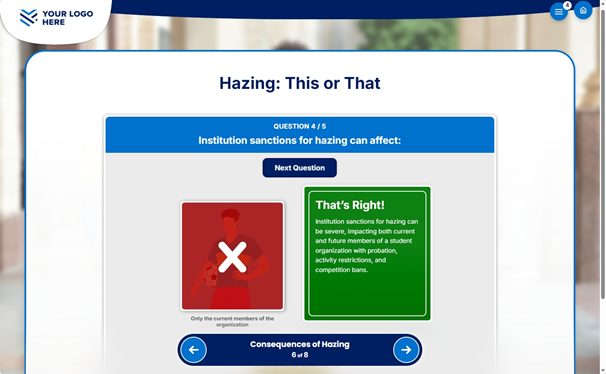
The Advantage Hazing Prevention Learning Module was developed with Dr. Wolcott as a subject matter expert to address the gap he experienced when adjudicating cases and creating protocols on his own. The module covers definitions so institutions can compare with campus policies, explores the psychology of why hazing occurs and persists, and provides preventative measures campuses can implement. Different sections serve students and faculty/staff/administrators/advisors, with video components featuring real people and relatable stories.
What makes it effective is its adaptability, allowing institutions to incorporate their own campus partner information or even create additional sections to support their unique campus needs and goals. Plus, it has different versions for students and staff, ensuring the content is relevant for all roles and responsibilities.
Your Path Forward
The framework for a healthy campus ready to defend against hazing is clear:
- Designated leadership backed by comprehensive partnerships
- A three-step approach to establish policy and infrastructure
- Training that prepares your entire campus community to protect students and foster healthy belonging.
Creating an environment where students can thrive without fear of hazing requires proactive effort, but the tools and strategies exist to make it achievable. If your institution is struggling with where to begin, lacks comprehensive training resources, or wants to strengthen its prevention infrastructure, this framework offers a roadmap. Request a live tour of the Advantage Hazing Prevention Learning Module to discover how comprehensive training can support your prevention efforts while preparing students, faculty, and staff to recognize, prevent, and respond to hazing.
"If you don't know where to start, the module is a great place. It'll help identify your priorities. This is critical work that needs to be done well."