

Most institutions build one orientation for everyone. It's a resource reality. A single, well-designed experience that covers the essentials is a meaningful investment, and for the majority of incoming students, it works.
But some student populations arrive with circumstances that a general orientation cannot address. Scholarship recipients have eligibility requirements to understand and maintain. Student athletes navigate schedules and support structures unique to their experience. Dual-enrollment students straddle two institutions at once. For these cohorts, a general orientation might check the box, but it can't speak to what makes their situation distinct, introduce them to the staff dedicated to their success, or activate the specific resources waiting for them.
That gap is exactly what the Community College of Philadelphia set out to close.
A Scholarship Named for a Legacy
In 2021, the City of Philadelphia launched the Octavius Catto Scholarship — a Promise Program in the form of an anti-poverty initiative giving Philadelphia residents access to a free college option. The city committed $47.4 million over five years to the scholarship, covering last-dollar tuition, a monthly basic needs stipend, bookstore credit, and a dedicated Success Coach for every scholar. Approximately 1,700 students enrolled as Catto Scholars in the 2023-24 academic year alone.
The scholarship is named for Octavius Valentine Catto, a civil rights leader, educator, baseball player, and voting-rights advocate who became one of Philadelphia's most important and most overlooked historical figures. Catto spent his life fighting for access to education and the right to vote and was fatally shot on Election Day 1871 at age 32 while mobilizing voters. In 2017, the City of Philadelphia unveiled a statue in his honor at City Hall.
The name isn't decoration. For Alexis Mercado, Acting Director of the Octavius Catto Scholarship, it sets the tone for everything the program represents — including how scholars are welcomed into it.
Building Catto JumpStart
CCP named their orientation Catto JumpStart, a standalone, scholar-only experience with no overlap with the college's general student orientation. Built across six sections, it moves from belonging to accountability to action — opening with Octavius Catto's story and the full scope of scholar benefits, walking through eligibility requirements as an accountability partnership rather than a compliance exercise, and closing with concrete next steps that activate the coach relationship before day one of class.
Threaded throughout are a College Resources component and a Canvas and Starfish overview so scholars aren't navigating those tools for the first time on day one. When a Catto Scholar finishes JumpStart, they don't need to go anywhere else.
The Case for Specialized Orientation
For Mercado, the decision to build a dedicated online orientation was both philosophical and practical.
"We enroll 700 students every fall. If this is in person, or if this is something that is on Zoom, we can't guarantee that the student is getting the same information. But by having this online orientation, we know for a fact that each student is getting the same exact experience."
That consistency matters in a program built around equity. For students who may be navigating higher education for the first time, getting the experience right every time, for every scholar, is not optional.
"We wanted to make sure that there was a baseline experience that each student was having, because we wanted to make sure that the goal is for them to be successful. For them to be informed, for them to feel acclimated."
JumpStart also lives in scholars' MyCCP login, so it's available as a reference when they need it, whether that's on day one or 100.
Results Worth Sharing
Research for Action evaluated the Catto Scholarship across its first two and a half years. Catto scholars retained at a fall-to-spring rate of 86.7%, compared to 77.2% for non-Catto CCP students. They persisted into their second year at 69.2% versus 55.2%. Three-year degree completion stands at 36%, double the college's graduation rate.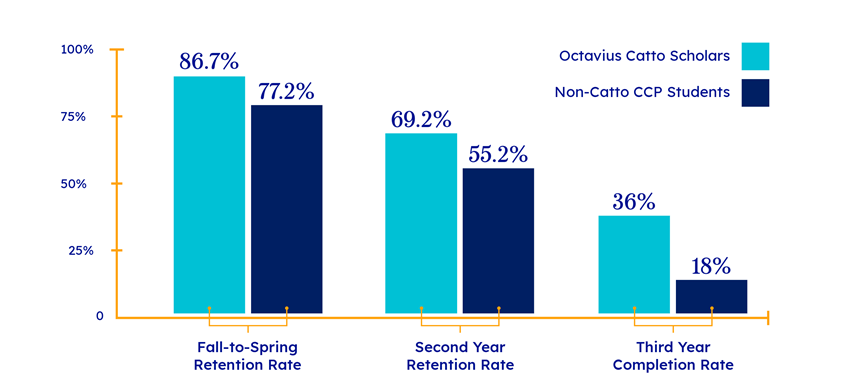 Those outcomes belong to the holistic support model that CCP uses, a staff of about 30 people working to make sure every scholar gets to the finish line. Orientation is where that support begins.
The Funding Question
The Catto JumpStart orientation was funded by the scholarship itself. CCP and the City of Philadelphia recognized that investing in scholars without investing in the experience that activates that support was leaving students without what they needed to succeed. Orientation wasn't overhead, it was infrastructure.
The Catto Scholarship is a Promise Program, a last-dollar funding model now adopted by more than 450 programs across all fifty states. Institutions with students on any Promise Program already have a defined cohort with dedicated funding and a natural candidate for a specialized orientation. To find out whether your institution has a Promise Program, visit mypromisetool.org.
Promise Programs are one avenue, but far from the only one. Various federal programs including TRIO Student Support Services, GEAR UP, and Title III of the Higher Education Act all fund wraparound services for defined student populations, and orientation is an allowable use, including:
- TRIO Student Support Services
- GEAR UP, and other Higher Education Grants
- Title III of the Higher Education Act
Named scholarships and endowments, honors programs, athletic scholarships, and workforce grants represent other cohorts with dedicated funding already in place.
The question most institutions ask is whether they can afford a specialized orientation. The more useful question is whether they already have funding that could support one. For most, the answer is yes.
Interested in exploring what a specialized orientation could look like for your institution? Request a live tour of Advantage Orientation.