

How Duke's Multi-Audience Graduate Orientation is Built to Evolve
Discover the centralized Guidepost with school-specific courses that transformed orientation for 2,400+ students across 8 graduate and professional schools.
Genille Anderson and Sarah Levine faced a complex puzzle. As leaders of Graduate and Professional Student Services at Duke University, they needed to orient 2,400 graduate and professional students across nearly a dozen schools—students with year-round start dates, varying levels of on-campus time, and programs ranging from 10 months to 10 years. The old approach wasn't working. Each school handled orientation independently, leaving campus partners to field the same requests for information multiple times. Communications were scattered across emails and webinars without a central hub, so students missed important information.
Duke had a secret weapon: their undergraduate program had launched their Advantage Orientation®, Blue Book, the year prior. Almost immediately, campus partners started asking Genille: "Are you doing this for grad students too?" The question seemed overwhelming at first, given the diversity of the graduate population, but then came the breakthrough—they didn't have to start from scratch. They could copy and adapt content from the undergraduate Blue Book platform. Even more surprising? The buy-in. Genille's team expected two or three schools to be interested. Eight schools immediately asked to be involved.
The Philosophy That Made It Possible
What enabled Duke to move so quickly, from starting in February to launching in May, was a fundamental shift in mindset. The team recognized that the platform needed to change continuously as needs evolved, regulations updated, and new information became available. Waiting for a "perfect" launch would mean never launching at all. This philosophy of continuous improvement over initial perfection became the foundation of Duke's entire approach. The platform wasn't meant to be finished on day one. It was meant to grow.
"Give yourself permission to launch Year 1 with a basic foundation. It's better to improve than wait for perfection."
One Hub, Eight Identities
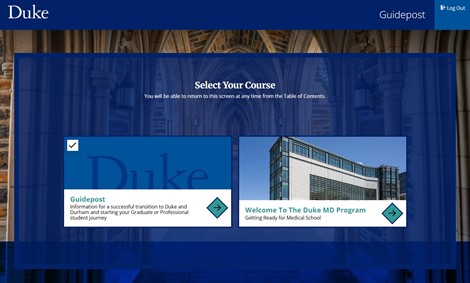
Duke's solution centered on its structure: a centralized Guidepost Course paired with individual school-specific Courses. The Guidepost Course serves as the foundation—a centralized Student Affairs module available to all graduate and professional students. It contains information relevant to all students, remains available year-round to accommodate various start dates, and serves as a reference students can return to at any time throughout their time at Duke.
Eight schools then built their own Courses, customizing their own unique content while relying on Guidepost to cover general university information. Students can navigate flexibly, starting with either Guidepost or their program's course. Schools determine how much or how little customization they want to include. The result? Centralized consistency where it matters, with room for each school to maintain its unique identity and address its students' specific needs.
What Makes Guidepost Work
Guidepost houses the universal information every student needs, like immunization requirements and transportation options. Each campus partner then has their own section to populate, solving one of Duke's biggest pain points. Now, partners like Recreation, Athletics, and Arts at Duke only need to update their content once, and everyone can access it. Plus, Guidepost also houses Duke's required Title IX training materials, keeping the Student Services office compliant while providing students with the information they need.
The efficiency gain was immediate. Instead of being contacted repeatedly by different programs requesting the same information, campus partners maintain their content in one place. The graduate schools benefit too—they can point students to comprehensive, current information without managing multiple partner relationships. An unexpected benefit emerged: new staff members started using these sections to learn about campus resources, turning the orientation platform into a cross-campus training tool.
Schools Making It Their Own
Within their individual Courses, schools have flexibility to create experiences that reflect their unique identity. Some schools created extensive video content—slideshows introducing staff, walking interviews with directors. Others used simpler approaches with welcome letters and photos. Both work. The platform accommodates whatever format schools already have available, getting welcoming content to students without requiring massive additional work using:
- Visual callouts to highlight important information
- External links to point students to existing school resources
- Dropdowns to organize complex program requirements clearly
- Checklists to keep students and staff on the same page regardless of when students start during the year
The key message from Duke? Programs don't have to create anything new. The platform can be professional and impactful using content schools already have.
A Platform That Grows
Duke's orientation platform isn't static. It adjusts as needs arise—updating to reflect regulatory changes and adding information based on student feedback and staff insights. Looking to Year 2, Duke is moving to an even more integrated approach with their undergraduate team; combined communications, single requests to campus partners, and breaking down silos while increasing efficiency across the entire university.
The results speak for themselves. The platform reduces duplicate efforts, streamlines communication across campus, and provides a central hub everyone can work from. All the while, students get consistent, current information year-round, not just during orientation week.
Lessons from Duke's Journey
For institutions considering a similar path, Duke's team offers straightforward advice:
- Don't go it alone. Include campus partners as subject matter experts.
- Start with what you have. Use the content you've already created as a kickoff point, whether it's an undergraduate platform or a slide deck.
- Give yourself permission. Launch Year 1 with a basic foundation. It's better to improve than wait for perfection.
The transformation won't happen overnight, but Duke's three-month timeline proves it doesn't have to take years, either.
Your Own Central Hub
Duke's transformation from fragmented to focused demonstrates what is possible when graduate and professional programs give themselves permission to launch imperfectly, build on what they already have, and create a central hub that reduces redundancy while allowing schools to maintain their identity.
If your institution struggles with information scattered across multiple channels, campus partners overwhelmed by duplicate requests, inconsistent messaging to diverse student populations, or serving students with different start dates year-round, Duke's story offers a roadmap. The answer isn't perfection at launch. It's a living platform that grows with you.
Request a live tour of Advantage Orientation® to discover how centralized hubs with customizable courses can transform your graduate student experience while making life easier for your entire team.