

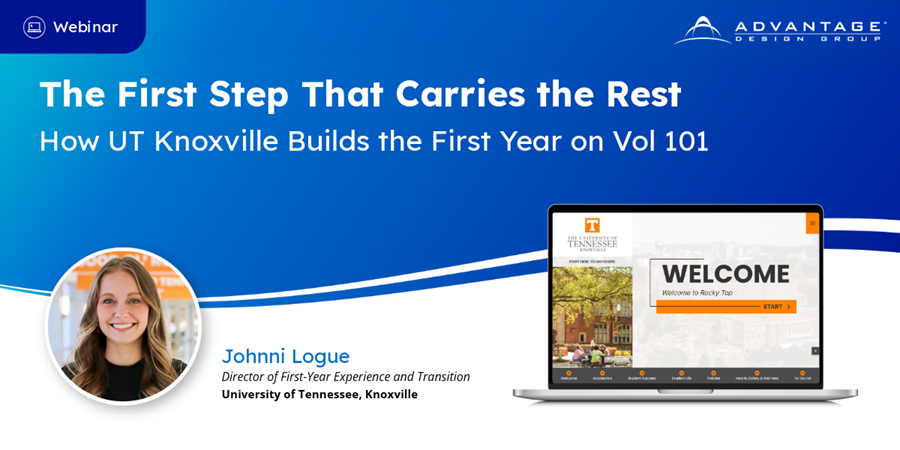
The University of Tennessee, Knoxville is Tennessee's flagship university, and its student population is growing fast with more than 41,000 students call UT Knoxville home. This past fall, the university welcomed approximately 9,000 new first-year and transfer students, each beginning their experience with Vol 101, UT Knoxville’s online orientation built on Advantage Orientation.
During a recent webinar hosted in partnership with NODA, Johnni Logue, Director of First-Year Experience and Transition at UT Knoxville, shared how her team restructured online orientation to meet students’ needs, bring campus partners together and create a stronger starting point for the entire first-year experience.
Rebuilding the Foundation
UT Knoxville replaced its traditional two-day orientation model with the New Vol Experience, a sequence spanning online orientation, advising, an in-person orientation day, six weeks of welcome programming, a first-year seminar and a spring return orientation.
As the only stage students complete before arriving on campus, Vol 101 carries a unique responsibility for establishing a strong foundation. Yet, when Logue and her team began improving the experience, they uncovered three challenges:
- Valuable student feedback was going unused. Years of survey responses offered insights into what students needed, but those comments had not been fully explored.
- The same content wasn’t relevant to every student. Students arrived with different circumstances and priorities, yet not all information applied equally to everyone.
- Campus partners needed evidence of engagement. Partners wanted to know whether students were reviewing the information and benefiting from the experience.
These challenges became an opportunity to rethink what online orientation could accomplish.
From Challenges to Solutions
1. Turning Student Feedback Into a Better Experience
Logue started by reviewing student survey comments, using their feedback to guide a complete overhaul of Vol 101’s content.
The survey responses revealed that students wanted more than written instructions. They wanted video tutorials, authentic perspectives and a clearer picture of life at UT Knoxville.
The team responded with instructional videos and welcome videos featuring real students and campus locations. Although Vol 101 grew from approximately 30 minutes to more than an hour, Logue reported no pushback about its increased length.
The team also took advantage of the flexibility to respond to immediate needs. When two-factor authentication launched in mid-June, Logue added a slide featuring a campus IT video that same day, rather than waiting for the next annual update.

2. Making Orientation More Personal
With approximately 9,000 new students, UT Knoxville needed to deliver specialized information without asking everyone to navigate content that didn't apply to them.
Using self-directed slides, students can identify their circumstances and access relevant guidance. Member groups take personalization further by displaying designated content only to specific populations. The Honors program, for example, now has its own module of approximately 15 slides.
These features also transformed how the Veterans Success Center shared information. The team moved veterans’ benefits guidance previously covered in a three-hour, in-person session into Vol 101, organizing it into step-by-step checklists. Students can also identify themselves through their military-affiliated benefits, including those using a parent's GI Bill.
The change made a tangible difference. As Logue explained, “Before this, the [veterans] office was chasing students down to get those forms in. Now they come in on time and the questions have dropped way off.”
By delivering the right information to the right students, Vol 101 helps campus partners communicate more effectively while giving students more relevant experiences.
3. Turning Student Engagement into Insight
Personalization addressed what students needed to see. The next question was whether they were engaging with it.
Advantage Orientation enables teams to add timers to slides and require students to open accordions and reveals. Logue also incorporated attestations, which ask students to acknowledge that they’ve read and understood specific information or policies, along with quiz questions at the end of sections to assess understanding.
Together, these features give Logue detailed reporting down to the individual student. When campus partners ask whether students have engaged with specific information, she can show them the data.
"It's not a guess, it's data I can show."
That data also informs improvements. When students frequently miss a quiz question, Logue reviews the preceding slides to determine whether the content needs clarification. Instead of simply changing the question, she uses the results to strengthen the learning experience.
A Better In-Person Orientation Day
With essential information covered online, UT Knoxville could rethink its in-person orientation day, Vol 103. Rather than devoting so much time to information delivery, the experience now emphasizes small-group conversations, campus exploration and community building.
Logue described students arriving “knowledge comfortable” after completing Vol 101. With the basics already covered, they can focus on connecting with others and becoming part of the university community.
The Results of a Stronger Start
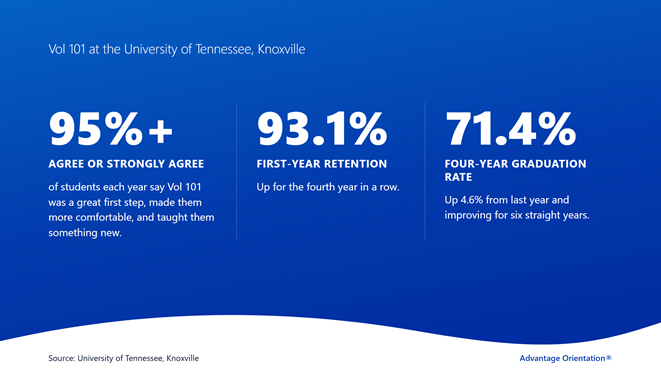
Logue credits many efforts across UT Knoxville for those gains, with Vol 101 and the improvements to the whole orientation process among them.
Watch the Full Webinar & Request a Recording
See Vol 101 for yourself. In the full recording, the Advantage team walks through UTK’s Advantage Orientation live, and Logue answers audience questions about where to start.
Frequently Asked Questions
How can online orientation be personalized for different student groups?
Advantage Orientation offers two ways to personalize content: self-directed slides and member groups.
Self-directed slides let students identify which circumstances apply to them, such as living on campus or commuting. Based on their selection, students are directed to the information most relevant to their needs.
Member groups allow institutions to assign specific content to designated student populations. Students automatically see the slides assigned to their group without needing to identify themselves, while students outside that group won’t see that content.
How long should online orientation be?
Relevance matters more than runtime. UT Knoxville’s Vol 101 grew from approximately 30 minutes to more than an hour as the team added content, video tutorials and authentic student perspectives.
Despite the increased length, the team hasn’t received pushback from students. Focus on providing the information students need in an engaging, useful format rather than shortening orientation simply to reduce its runtime.
How do you know students actually read online orientation content?
Build in opportunities to measure engagement and record it. UT Knoxville uses required accordions and reveals, attestations asking students to acknowledge that they’ve read and understood specific policies, and quizzes at the end of sections.
These features give the team access to detailed reports down to the individual student. Staff can pull those reports when needed to verify engagement with specific content, respond to stakeholder questions and identify opportunities to improve the orientation experience.
Related Stories