

Remember your first week at your current role. How many emails did you get? How much of their content did you actually retain?
For new hires at Pace Center for Girls, the answer was too many and not enough. Morgan Conway, Director of Talent Development, remembers the feedback clearly. Moreover, she remembers how it led to turnover.
That kind of start does more than frustrate people. It quietly breaks a promise.
"If you were promising me something during my interview, and then that’s not what I experienced my first day, or first week, or first 90 days in role, then I’m going to start asking some questions, like 'do I really want to see myself here long-term?'"
A Dispersed Workforce, an Inconsistent Day One
Pace Center for Girls is a nonprofit prevention program serving girls across Florida and into Georgia. Their traditional day program model puts academics and counseling on site at local centers, everything from math and science teachers to reading intervention to mental health services. They also run community-based REACH programs. And their national office, the team supporting all of it, is fully remote.
Their dispersed workforce and variety of roles mean no two first days look alike. A new hire at a center walks in while girls are checking in and meets the front office face to face. A national office hire might meet their manager for the first time over Teams. And the person responsible for making sure they all receive the same critical information sits somewhere else entirely.
As Morgan puts it, from where she sits in national, she is an email. She is not the person giving you a tour of your building or eating lunch in the break room with you. So Pace had to acknowledge something before they could fix anything: orientation is a shared responsibility. Their current program struggled to meet their needs, with:
- A long welcome email from people and culture.
- Too much information arriving too fast.
- New hires stepping into classrooms and counseling sessions without a real foundation in who Pace is or what was expected of them.
- In some cases, a gap between what recruiting described and what people actually walked into.
The result was new hires who felt unprepared and overwhelmed, and Pace experienced high turnover inside the first 90 days.
Orientation as the Promise-Keeper
Leadership agreed the status quo was not sustainable, but the shift in thinking was important. Recruiting makes promises. Orientation is where an organization either keeps them or does not.
"We started looking at orientation as a place where we could keep those promises from the start.”
Morgan frames it that new hires are consumers, just like any person is. What an organization says it represents on its website must be what a new hire actually experiences, because people will notice the difference. You do not stop selling yourself once someone signs. You keep recommitting, showing them you are in it for the long haul.
Pace went in knowing this was not an overnight fix. Five years later, it is still a priority, because there is always a new facet that comes to life.
The Need for Orientation Expertise
Identifying what you want and being able to build it are different tasks. Morgan collected input from centers across the organization and faced a practical question: how do you turn all of that information into something real, on a timeline, without wasting the time of everyone who contributed?
Her answer? Advantage HR Engage. With pricing that fit into their nonprofit budget, she also prioritized the expertise of the Advantage team. Advantage had built orientations many times before. That experience showed up in the planning templates, which had a way of surfacing questions Pace had not asked itself. It became a system of checks and balances, and Morgan describes it as guidance that would have taken her team years to find on their own. The process itself, she says, made them better as an organization.
Then there was the part no template solves. Professional video, lighting, direction, scripting. Pace doesn't keep these roles on staff, but outsourcing them to multiple companies wasn't logistically or economically viable. Advantage brought the equipment, ran the production, and coached Pace team members through it.
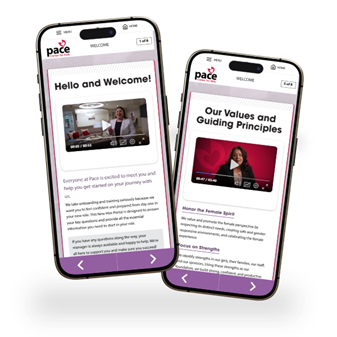
Everything in Pace’s videos features real Pace team members and real girls. That was intentional, because Morgan wanted new hires grounded in the understanding that this is not a mission posted on a wall and a website. It is one the organization actually believes.
The scripts, she says, did not feel like a box. They felt like tools she could use to build her own sandcastle. And when it all came together, the result was a relief.
“It went from disjointed to streamlined and effective and really intentional."
What a Strong Start Actually Looks Like
The orientation Pace built opens the way Morgan wanted it to open: with a person, not a wall of text. A welcome video greets new hires and walks them through how the experience works. From there, they meet Pace’s values and guiding principles, a letter from the president and CEO, the faces of an executive leadership team many of them would otherwise never meet, and the core values video that is the heart of the whole thing. Beyond that, every system a new hire needs lives in one place, so there is a single answer to the question of 'where do I find that.'
The policies section might be the clearest example of the philosophy. Pace’s policy manual is comprehensive and long, and Morgan says handing that to someone in their first few days is an unrealistic expectation. So, her team worked with programs and employee relations to identify what is genuinely make-or-break, put those highlights in the orientation, and showed new hires exactly where to find everything else when they need it. Learning takes time, and expecting day-one mastery leads to burnout for everyone involved.
How Implementation Became Adoption
Building the orientation was one project. Getting an organization to use it was another.
When it came to adoption, Morgan prioritized trust and collaboration. She connected with and listened to key stakeholders, responding to their feedback and making adjustments as needed. The moment Morgan calls her favorite came when a committee of experienced executive directors, the top tier of leadership at their day programs, asked to review their Advantage HR Engage orientation. She describes it as a vulnerable moment. Fortunately, the feedback was overwhelmingly positive, and they brought real, on-the-ground suggestions that made it better.
Sometimes, she says, you have to take yourself outside the HR bubble.
Now the signals are adding up. Utilization reports from the back-end data tracking tool are strong. Facilitators running live virtual onboarding are hearing new hires reference the portal. The built-in survey is becoming a benchmark Pace can measure against their 30-day and 90-day check-ins, and the team is moving to a quarterly review of what comes back.
A Strength-Based Orientation
Pace is a strength-based organization. Nobody expects a girl to walk in on day one and be perfect. Everyone knows she will need support, wraparound care, and time to reach a place of confidence. Morgan’s argument is that new hires deserve the same grace, and that HR professionals should examine the assumption that a team member should simply know how to do everything correctly from the start.
It matters more than usual at Pace, where a center might have exactly one science teacher, one reading teacher, one counselor. There is no colleague down the hall doing the same job to ask for help. That can feel isolating fast. So, the orientation exists to say something specific: we hear you, we know this is a lot, and you are not on an island.
That, Morgan says, is the difference between being thrown in and being welcomed in.
Advice for a Stronger Day One
For anyone considering this work, she offered three suggestions.
- Get leadership buy-in and treat it as a long-term commitment rather than a quick fix.
- Root everything in your mission and your culture. Policies change, and procedures change, but a message grounded in who you are will last through whatever comes.
- Challenge yourself not just to say something, but to really make sure that what you are saying is what they are going to be experiencing.
Want to create a stronger day one at your organization? Request a live tour of Advantage HR Engage to discover how a purpose-built digital orientation can reach every new hire, reflect your culture, and give your HR team the visibility and time to focus on what matters most.