

How UMass Amherst Cut Completion Time in Half and Boosted On-Time Completions by 16%
When Jonathan Tunwar and Ashley Braziel of University of Massachusetts Amherst's New Student and Family Programs set out to redesign their online pre-orientation, they didn't just want incremental improvements, they wanted transformation. Through a data-driven, collaborative approach, they achieved exactly that:
- 50% reduction in completion time
- 16% increase in on-time completions
- 5.3% increase in overall completion rates
Here's how they did it.
Using Data to Identify Drop-Offs
When Ashley Braziel joined UMass Amherst as Associate Director of New Student and Family Programs in November 2024, one of her first projects was evaluating their existing online pre-orientation. Rather than guessing what needed to change, she turned to the data. Using the Advantage Orientation® administration panel, she accessed detailed completion and drop-off analytics that revealed students were taking over 2 hours to complete the experience, with the academic advising module showing the most problematic drop-off. This was particularly critical since completion of that module was required before students could schedule their advising appointments.
Beyond the numbers, broader challenges emerged. Their content strategy felt outdated. What worked five or more years ago wasn't resonating with current students anymore. The experience was too long and students lost engagement partway through. The same topics were covered in both the online and in-person orientations, causing redundancy. Plus, a branding disconnect meant that their digital experience didn't match the quality and aesthetic that students expected from a flagship institution.
The Strategic Redesign
Once they identified the problems, Jonathan and Ashley knew they needed a strategic approach to solve them. A philosophy shift was crucial.
"We stopped trying to cover everything in our online modules. And what we really asked is: what information do students absolutely need before they come to our on campus orientation program?"
This question helped them eliminate redundancy and respect students' time in a way they hadn't before. The structural reorganization was significant. They reduced their ten existing content-heavy sections down to six focused modules plus two short summary sections. At the heart of their philosophy was a clear goal: reduce completion time from over two hours to just one.
A lofty goal like theirs required more than just an orientation office project, it called for campus-wide collaboration. They brought in marketing and communications for branding and video production, IT for technical integration, and academic advising for content guidance. Giving each partner ownership over their content area created buy-in and delivered better results. They also enhanced engagement through interactive elements like tiles for visual navigation, I-buttons for layered content that students could explore on their own, games to maintain interest, and updated videos featuring current students.
A Measurable Impact
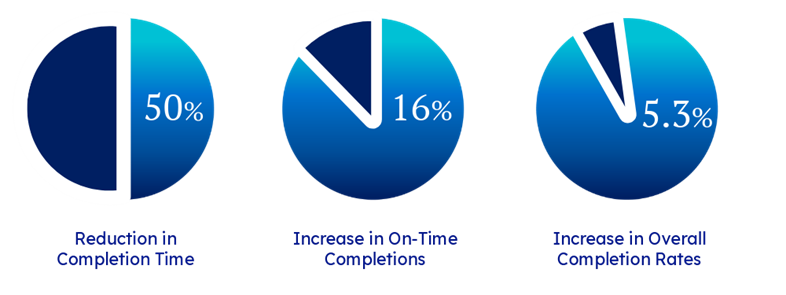
The redesign delivered the results that Jonathan and Ashley were after. With a 5.3% increase in completion rate, a 16% increase in on-time completion, and a 50% reduction in average completion time, the impact was measurable.
"These weren't just really marginal improvements for us. These were really game changing results for our office and for our students."Their achievements weren't limited to the numbers. Academic advisors and advising leads began consistently reporting that students arrived better prepared for their appointments. Students were more familiar with how to complete the pre-orientation and found the newer design more engaging. They were better informed about registration processes and the move-in experience, resulting in fewer questions to advisors. There was also a measurable reduction in FERPA-related inquiries from family members, and advising appointment scheduling became more efficient because students were completing the pre-orientation on time.
Students consistently reported that the updated aesthetic quality and interactive features met their expectations for UMass. The key learning has been to track where students are in the process and use that data to identify bottlenecks. When they saw students getting stuck in the advising module, they knew exactly what to fix. They continue to monitor data through the admin panel and student survey feedback, making adjustments as needed. It's not "set it and forget it", it's an ongoing process.
"Feedback was overwhelmingly positive. The new experience was much shorter, more concise, and it had better information flow. And it felt more interactive."
Lessons from UMass Amherst
UMass Amherst's success wasn't luck. It came from intentional goal-setting, data tracking, and a willingness to challenge existing norms. Their greatest takeaway? Start with data. Track your completion rates, time-to-complete, and drop-off points. If you don't have an online pre-orientation yet, gather data on what questions students and families are asking before arrival. Beyond metrics, encourage your team to:
- Conduct a content audit asking what students need before arrival and where you're repeating information across touchpoints.
- Build collaborative partnerships by identifying key stakeholders early, involving partners in beta testing, and celebrating wins together.
- Balance comprehensiveness with conciseness. Students retain more from a focused one-hour experience than a sprawling two-plus hour one.
- Use interactive features to layer content and improve engagement and information retention.
Want to learn more about Advantage Orientation® and how it can support your orientation efforts? Book a live tour today with the form in the sidebar!
Already have an Advantage Orientation®? Contact our Client Success team at clientsuccess@advantagedesigngroup.com and we'll help you take it to the next level!